I’ve been applying for tech/data jobs for a while now.
Mostly silence. Occasional rejections. The rare first-round interview that goes nowhere.
At some point around midnight, I had a thought: what if I had just become a plumber?
Not a crisis. Just a question: what if plumbing — an actual job with demand, decent pay, and no AI to replace you tomorrow — was actually the better choice?
So I looked at the numbers.
The advice wasn’t wrong
Before I get into it — the people who told me to go into tech weren’t lying.
In 2019 the numbers actually backed it up. Bootcamps were saying 80%+ of graduates got jobs. People were getting hired. “Learn to code” was on every YouTube channel, every LinkedIn post, your uncle at lebaran. And it made sense, because it was basically true.
About 18,000 people graduated from coding bootcamps in 2019. By 2020 that jumped to 25,000 — a 39% jump in one year, mostly because COVID pushed everything online and everyone had time to learn stuff.
The bet made sense. And for a while, it was paying off.
Then two things happened at the same time
First: more and more people kept getting into tech.
More bootcamp grads. More CS graduates. More people who spent the pandemic on YouTube and Udemy and called themselves developers. The number of people applying for junior dev jobs kept going up.
Second: the jobs themselves started disappearing.
GitHub Copilot came out June 2022. ChatGPT November 2022. GPT-4 March 2023. These tools didn’t touch senior engineers — they took over the stuff that used to be entry-level work. Writing basic code, fixing small bugs, building simple features. The exact stuff you learn in a bootcamp.
Junior developers got squeezed from both sides at once. More people competing for fewer spots.
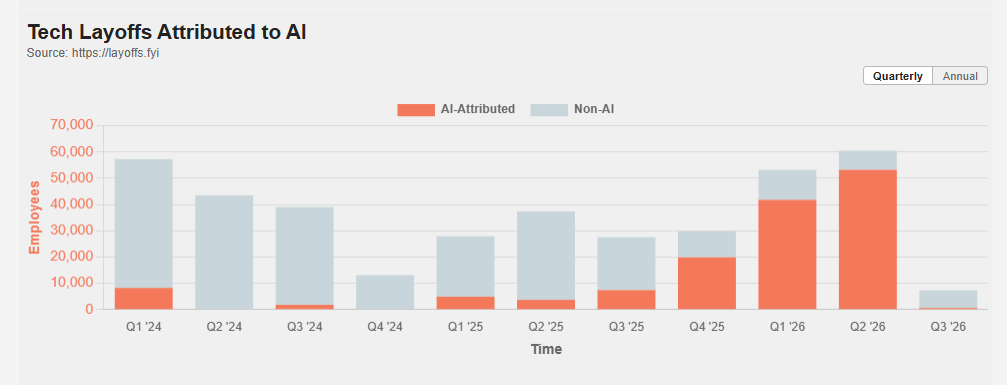
And then companies started being honest about why. Layoffs blamed on AI went up by 332% in 2025. By 2026 it’s the biggest it’s ever been.
The numbers
I want to be upfront: I’m just one person with public datasets. I’m not an economist. But the direction is hard to argue with.
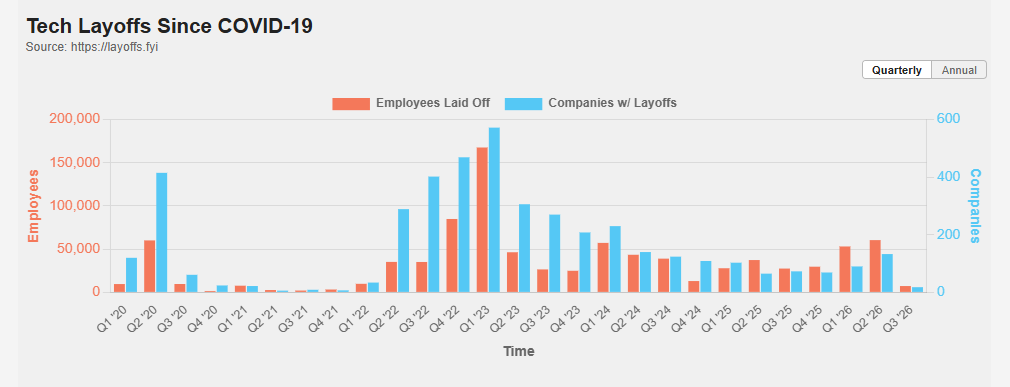
Tech layoffs: layoffs.fyi tracked about 265,000 tech workers laid off in 2023. That was the worst year. Before that, 165,000 in 2022. Then 153,000 in 2024, 123,000 in 2025. In four years that’s roughly 700,000 people.
Bootcamp placement: An independent auditor called CIRR checks bootcamp numbers. Their finding: 71% of graduates get a job within 6 months. Bootcamps love to lead with that number. But flip it around — 29% don’t. And “got a job” includes part-time, freelance, and QA roles — not just software engineer positions.
Junior salaries: I downloaded the Stack Overflow Developer Survey for 2019 and 2025 and ran the numbers myself. Median pay for junior US developers (0–2 years): $75,000 in 2019. $74,000 in 2025. Sounds the same right?
But look at the bottom. The 25th percentile — the people doing worst — dropped from $60,000 to $40,000.
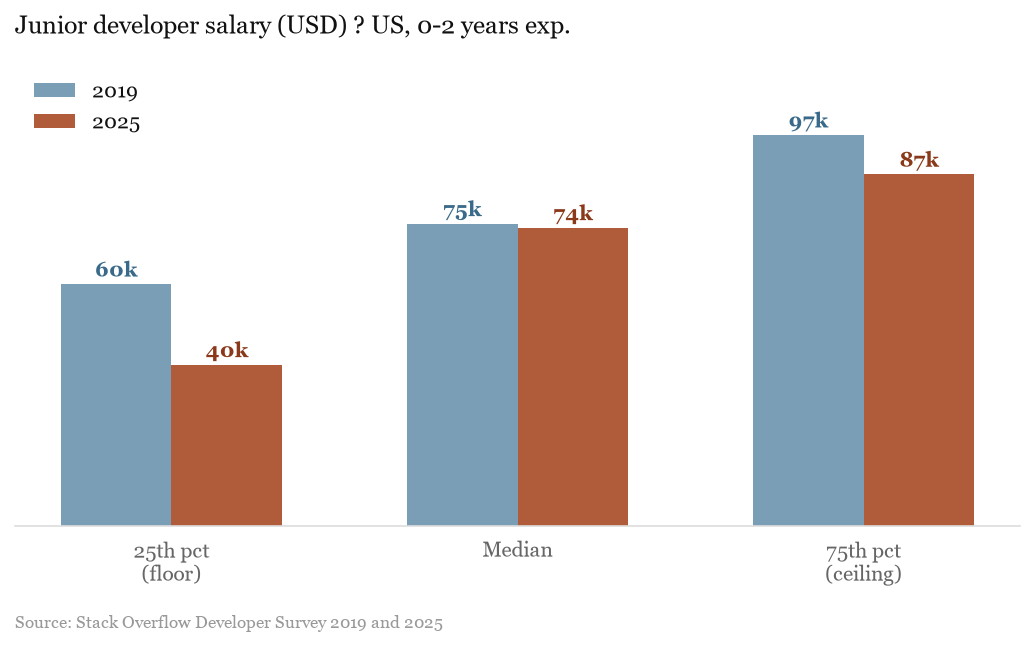
The people at the top are mostly fine. The people at the bottom are getting paid a lot less.
And here’s the one that actually got me. In the 2019 SO Survey, 1,857 junior US developers responded. In 2025: 58.
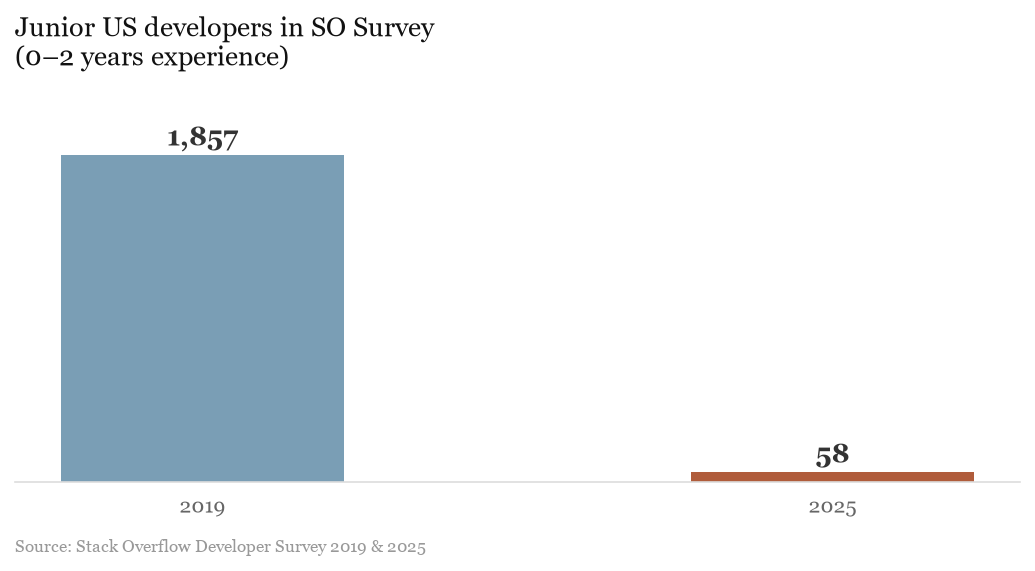
Fifty-eight.
Maybe they stopped taking surveys. Maybe they don’t think of themselves as developers yet because they’re still looking. I don’t know for sure. But 1,857 down to 58 is hard to explain away.
One honest thing I should say: BLS says software dev jobs will grow 15% by 2034. So tech isn’t dead. It’s growing. It’s just growing at the top, not at the bottom where most people are trying to get in.
So what about the plumber
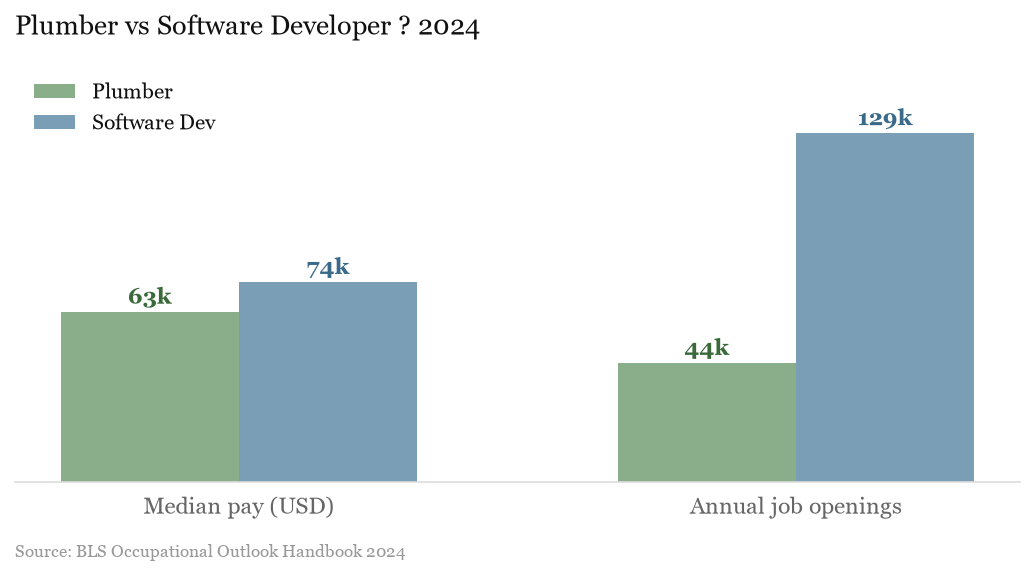
I actually looked this up. Here’s what the US Bureau of Labor Statistics says for 2024:
Median pay: $62,970 a year.
Projected job openings each year: 44,000.
The growth rate is only 4% — not exciting. But those 44,000 openings aren’t from growth. They’re from retirement. The people doing this job right now are getting old, and not enough young people are coming in to replace them. There’s a real shortage.
The path in is also different from what I assumed. You do an apprenticeship — usually 4-5 years. But you get paid while you do it. Compare that to a bootcamp where you pay $15,000 before you know if you’ll get a job.
And the work can’t be done from a laptop in Bali. Can’t be sent to a cheaper country. Can’t (yet) be done by a robot — because pipes break in specific places, in specific ways, and you need to physically be there to fix them.
I’m not saying it’s easy. I’m not saying it’s for everyone. I’m saying I never thought to compare until now.
Why didn’t anyone tell me this
The people giving career advice live in the same bubble as the people getting it.
Everyone who writes about careers online works in tech. Bootcamps had money behind them and a reason to market hard. “Learn to code” spread because the people saying it were the ones who already made it work.
There’s also just a delay. The advice people were giving in 2022 was based on how things looked in 2019. By the time the market shifted, nobody updated the script. People are still telling their kids to do bootcamps.
I followed advice that was probably fine when it was given. It just might have been 3 years out of date by the time it reached me.
What I actually think
I’m not going to tell you to become a plumber. That would be a weird conclusion from some spreadsheets.
What I think is: when I decided to go into tech, I compared it to nothing. I didn’t look at the alternatives. I just went where everyone said to go.
If I was deciding now, I’d at least ask the question.
Tech still has a higher ceiling if you make it. Plumbing has a more predictable floor. For someone who went in because it “seemed safe” — which is honestly why most people do anything — the floor probably matters more than the ceiling.
Data: Stack Overflow Developer Survey 2019 and 2025 (raw CSV). US Bureau of Labor Statistics. Layoffs.fyi. CIRR bootcamp outcomes. All analysis in Python.