I wanted to figure out, with data, who the GOAT actually is.
I thought it would be simple. Pull the numbers, build a few charts, write it up.
It didn’t go that way.
The more I dug in, the more I realized the whole debate has been asking the wrong question for 20 years. Not because the answer is complicated — but because there isn’t one answer. They’re not even competing for the same thing.
Here’s what I found.
1. The career arc
The most common comparison is total goals. But it’s a bad one. Ronaldo is two years older, so he’s had more time to score. The honest comparison is goals per game, plotted by age — so we’re looking at the same point in each person’s life.
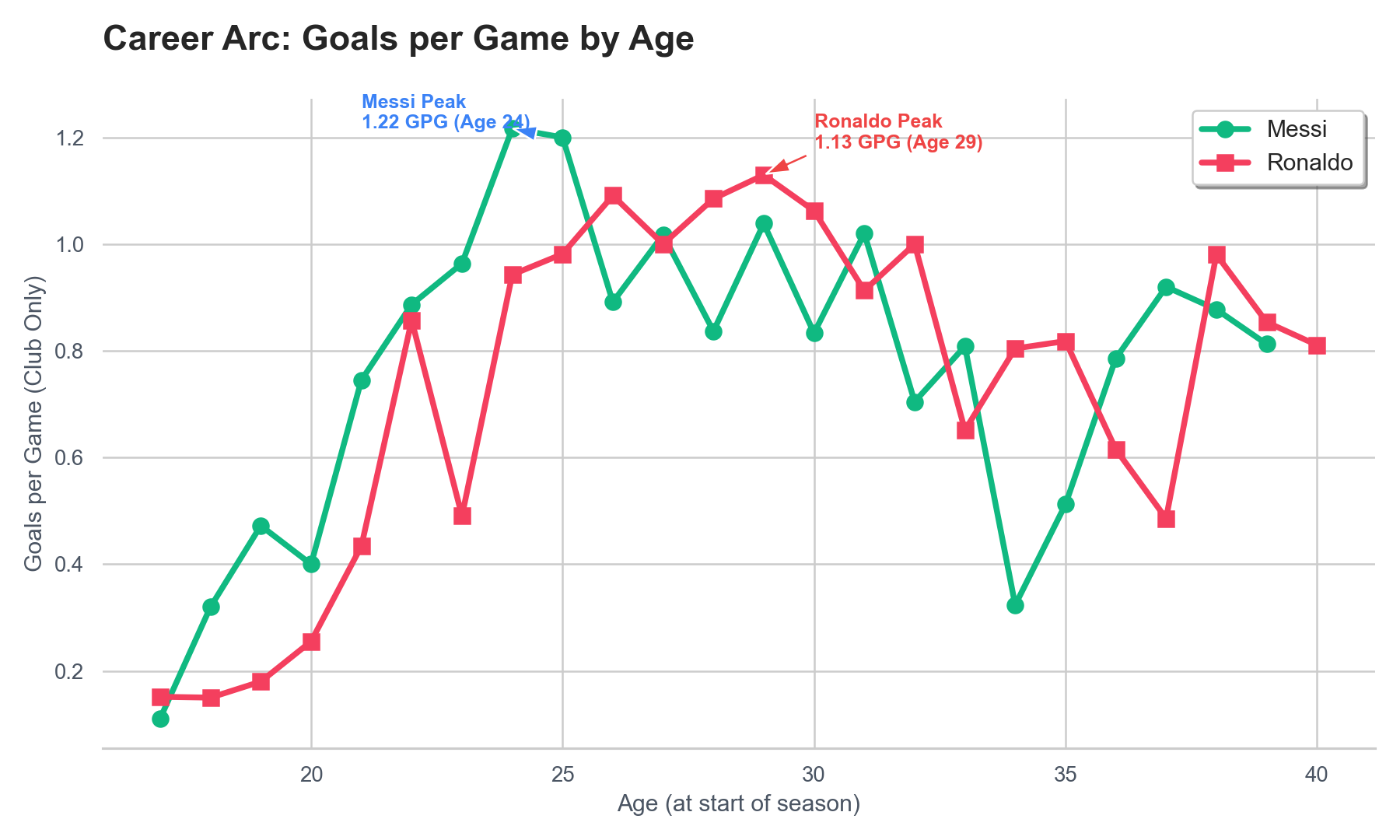
Messi at age 24 was doing something that shouldn’t be biologically possible. 73 goals in 60 games — 1.22 per game. That’s not a good season. That’s a different species.
Ronaldo’s peak was a bit later, around 29, and slightly lower at 1.13 per game. But look at what happens after 30. Messi’s line gradually comes down. Ronaldo’s just… doesn’t. He stayed at elite output well into his mid-30s in a way that most players physically can’t do.
So right at the start, you already get two completely different shapes. One was an early, insane peak. The other was a diesel engine that just kept running.
Neither is obviously better. They optimized for different things.
2. The “he disappears in big games” test
Every fan has said it at some point. “He’s great in regular games but goes missing when it matters.”
I wanted to check if there’s actually any truth to that — for either of them.
I split their entire careers in the Champions League and World Cup into group stage games versus knockout games, and calculated goals per game for each.
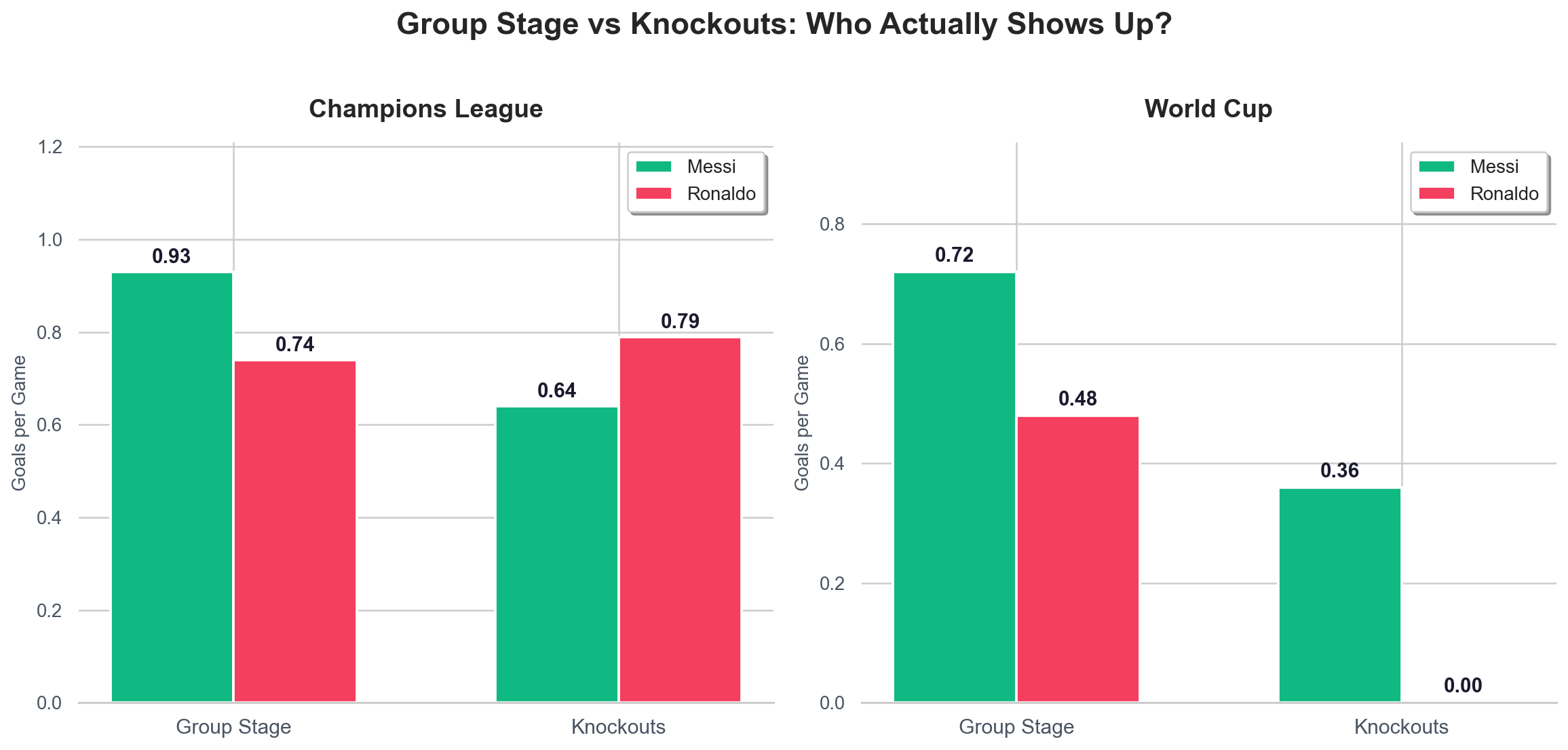
This chart killed a lot of talking points for me.
In the Champions League, Ronaldo is basically the same player in groups and in knockouts. 0.75 per game in groups, 0.79 in knockouts. He just shows up at an elite level regardless of the stage. Messi dips slightly in the knockouts (0.93 to 0.64), but 0.64 goals per game in Champions League knockout football is still elite by any real standard.
The World Cup is where it actually gets interesting. Messi’s numbers stay consistent across both stages — he scores at a similar rate whether it’s the group stage or a semifinal. Ronaldo scores at 0.48 per game in groups, and then drops to exactly zero in knockouts. Across his entire career. Six World Cups.
So “disappears in big games” is not quite right for either of them. But the World Cup knockout thing for Ronaldo is real. That’s not a small sample size. That’s a pattern.
3. The anatomy of a goal
Before getting into who’s more clutch and where, you need to understand how they actually score. Because it tells you a lot about what they’re doing on the pitch.
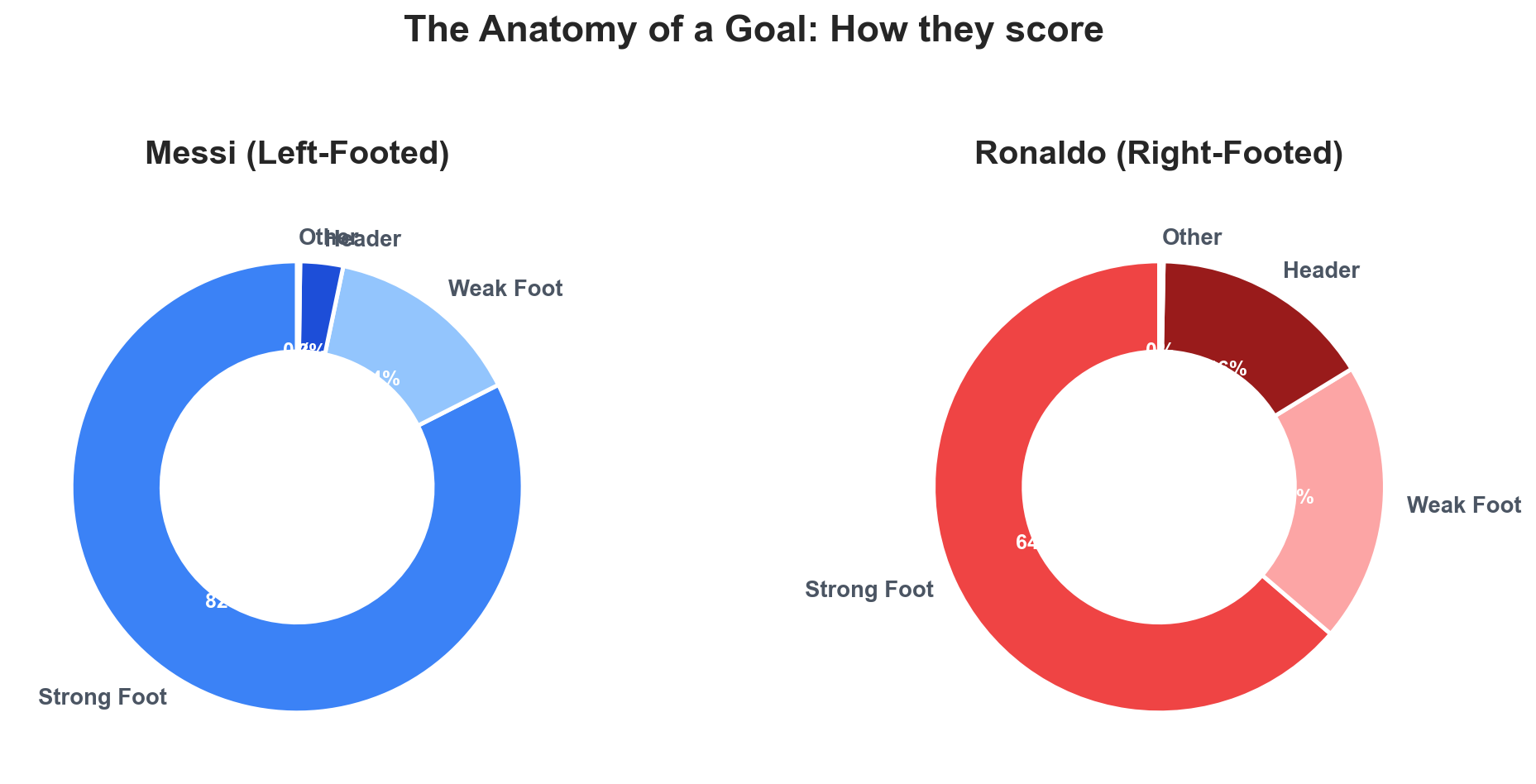
Ronaldo has over 150 career headers. That’s an almost absurd number. He spent years training specifically to win aerial duels, and it shows. He is probably the greatest aerial goalscorer in football history.
Messi has 28. He is 5’7”, doesn’t jump if he can avoid it, and scores over 82% of his goals with his left foot. He’ll go an entire career without being a threat in the air and still end up with 900+ goals.
They’re doing completely different things physically. One is dominating through athleticism and physicality. The other is doing it through touch, positioning, and an almost telepathic sense of where the ball is going to be.
4. The competition split
The clutch chapter in most Messi vs Ronaldo articles just lists raw totals: Ronaldo has 67 CL knockout goals, Messi has 49, Ronaldo wins. Or: Messi has 5 World Cup knockout goals, Ronaldo has 0, Messi wins.
But that’s still a totals argument, and we already established totals are misleading.
What’s more interesting is the bigger picture: where does each of them own a competition?
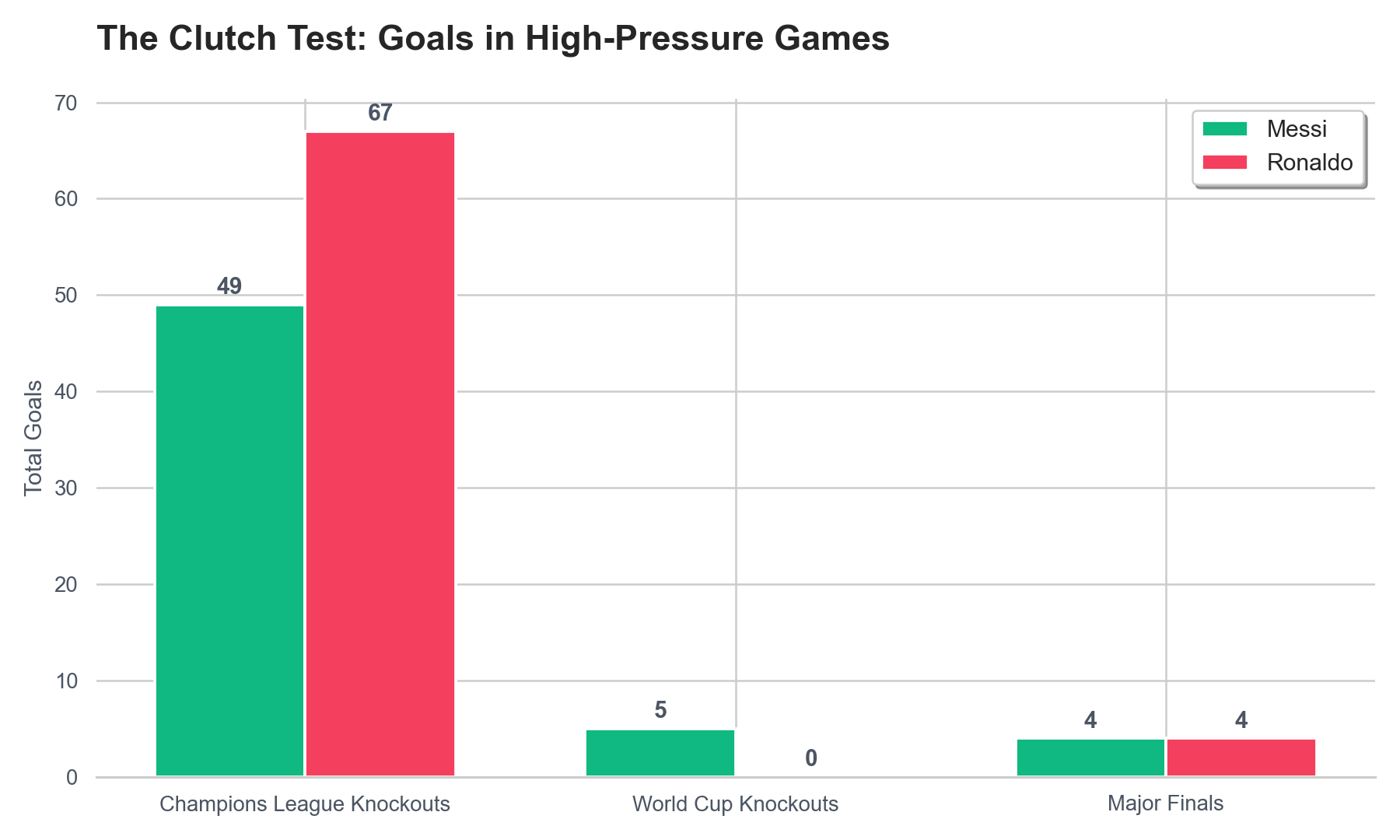
Ronaldo owns the Champions League knockouts. Not just slightly — by a significant margin. He has more CL knockout goals than any player in history, by a lot. This is one of the most impressive individual achievements in football.
Messi owns the World Cup knockout stage. His 5 goals in World Cup knockouts all came in one tournament (Qatar 2022) where he was arguably the best player on the planet for a month straight. Ronaldo has played in six World Cups and has never scored in the knockout stages.
Major finals? Dead even at 4 goals each.
What this tells you is that they peak in different competitions. The debate about who’s more clutch depends entirely on which competition you care about most. And that’s a values question, not a data question.
5. The shadow effect
Here’s the one that I think most people don’t think about enough.
Their goals are their goals. But what did playing with them — or losing them — do to the players around them?
I tracked four elite teammates before and after they parted ways with their respective GOAT.
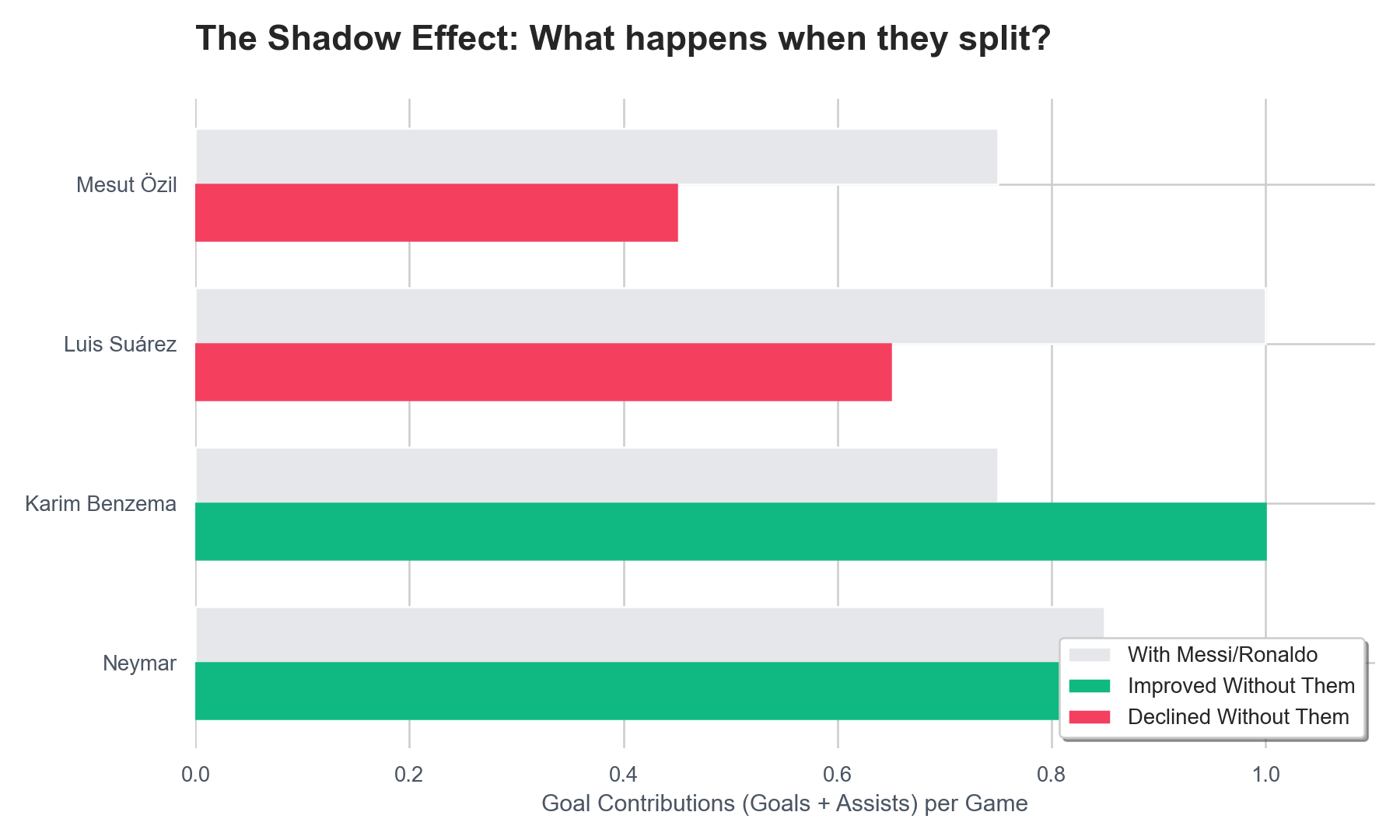
Two patterns emerged, and they’re almost perfectly clean.
The “freed” players: When Karim Benzema no longer had to play second fiddle to Ronaldo at Real Madrid, he became the main man, won a Ballon d’Or, and finished his career as one of the greatest strikers ever. When Neymar left Barcelona to be the guy at PSG rather than playing alongside Messi, his individual goal numbers went up.
The “dependent” players: When Luis Suárez left Barcelona and stopped receiving Messi’s passes, his production fell off sharply. Mesut Özil’s assist numbers tanked the moment Ronaldo wasn’t there to finish everything he created.
I’m not saying these players are only good because of the GOATs around them. They’re all elite players. But the data suggests that their styles of play created specific types of value for specific types of teammates. Not the same type.
6. The actual answer
After a few days of staring at this data, here’s what I think is actually happening.
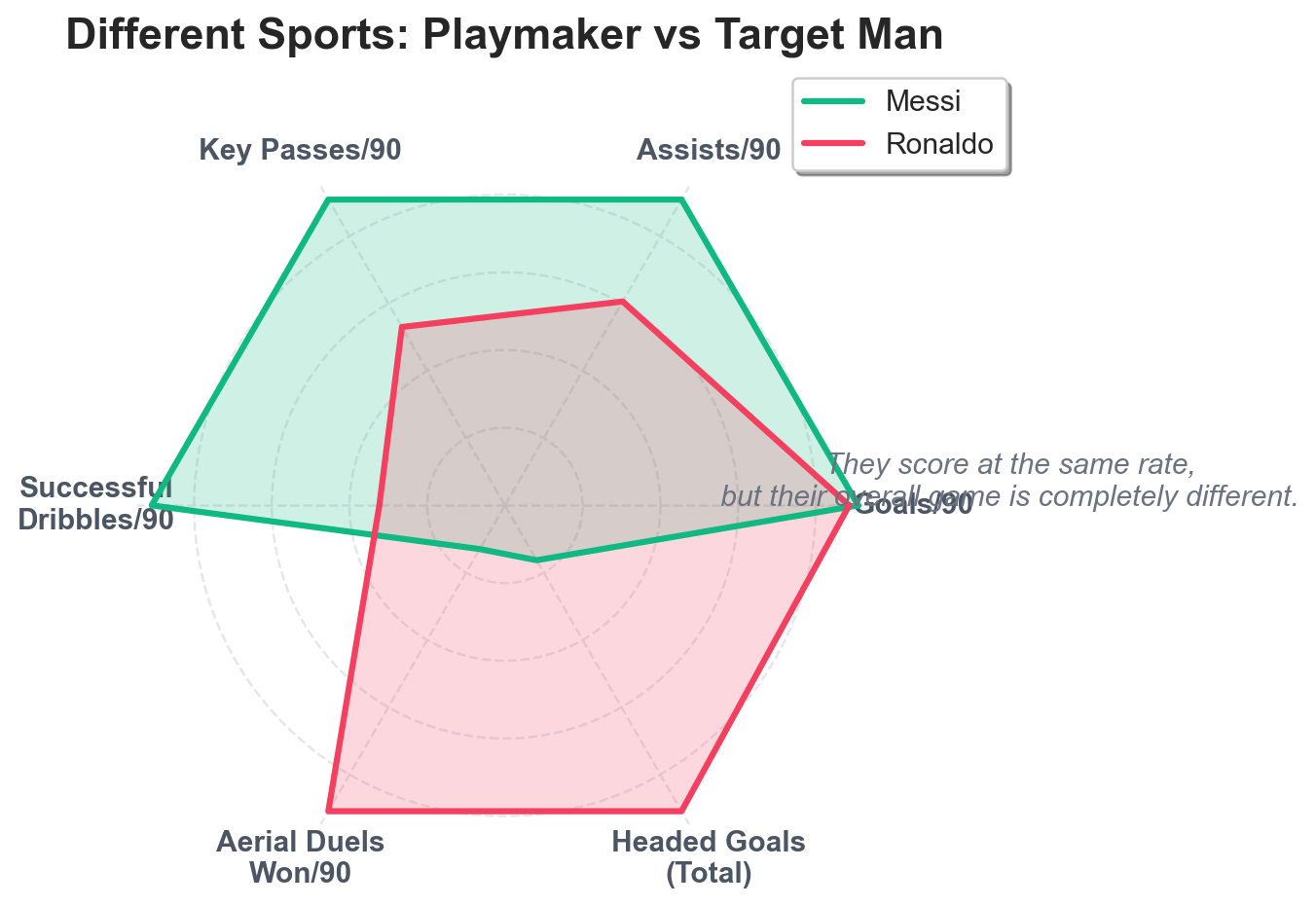
Their goals per 90 minutes are almost identical. But everything else is different. Dribbles per game, key passes, aerial duels, assists — completely different profiles.
Ronaldo is the most complete striker who’s ever played the game. Peak athleticism, elite in the air, clinical from anywhere inside the box, and a scoring machine at the absolute highest level for over 20 years.
Messi is not really a striker. He’s an attacking midfielder who scores like a striker. His assist numbers, his key passes, his ability to carry the ball through five players — that’s not what a traditional number nine does. He’s a different position that just happens to also score more than basically everyone who’s ever played.
Comparing their goal tallies is like comparing a Formula 1 driver to a rally driver. You can say who has more wins, but the tracks aren’t the same.
The question isn’t who is the GOAT. The question is GOAT at what, exactly?
(Obviously it’s Messi. I wrote the code, I pick the winner. Sorry, Cristiano.)
All stats sourced from Statmuse, FBref, and FIFA official records. Charts built in Python. Full code and data on GitHub.